|
Dystopian science fiction is a genre I've long enjoyed and when I came to write The Waste, there were several novels that influenced and inspired me. 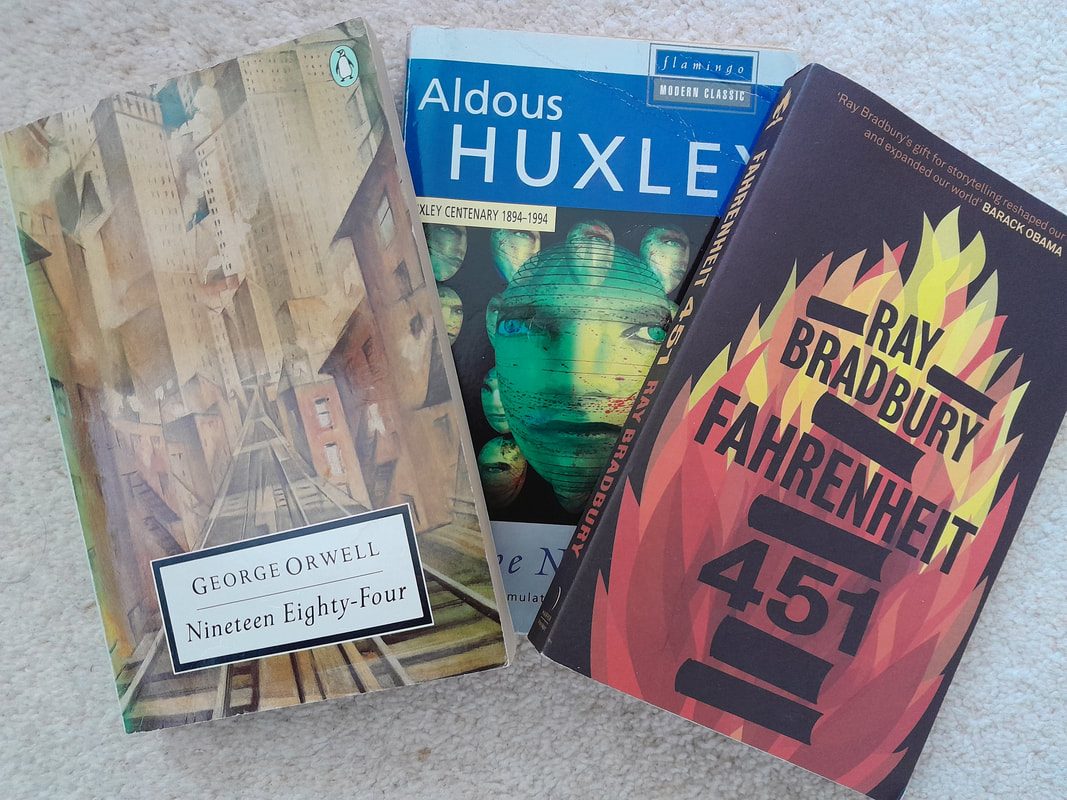 Brave New World by Aldous Huxley Brave New World is often cited as one of the most influential and prophetical books of the twentieth century. Set in the far future, the World Controllers of the story have strived to create a perfect world. Every individual receives pre-natal / post-natal conditioning so as to accept his or her position in society, from the Alpha-Plus ruling class to the Epsilon-Minus Semi-Morons who are bred to perform menial tasks. This society is perfectly ordered, and this control is strengthened through the state-endorsed use of the drug soma, and other pleasurable distractions. In many senses, the people of the novel are controlled by their pleasure and distractions; when life is so good and so easy, why even think to challenge the status quo, what would be the purpose? This is not a tyranny of brutal physical oppression, enforced by military strength and prison camps, but a tyranny in which the citizens are imprisoned in a gilded-cage of amusement and ease. I found this a fascinating concept: that a dystopian could be so insidious, almost hiding in plain sight with a benevolent façade. Some of the thematic elements of Brave New World certainly influenced parts of The Waste. In the society shaped by the alien Seraphim, people are encouraged to focus only on their own needs and pleasures, with any concerns for wider society deemed odd, even suspicious – like the genetically bred humans of Brave New World, do they even notice they are living in a dystopian world, or if they did, would they care? The titular Waste of my novel, a vast open-air prison, was also in part influenced by the Savage Reservation visited by Bernard Marx and Lenina Crowne in Brave New World. Brave New World still impresses with its brilliant invention and wit, and as time passes, I’d argue Huxley’s novel simply becomes more and more relevant, and perhaps more and more troubling. Nineteen Eighty-Four by George Orwell To the best of my memory, Nineteen Eighty-Four was the first dystopian novel I read and it is a book that certainly leaves a deep impression and although I have re-read it several times, its impact is never lessened. Airstrip-One feels like a nightmare, a crucible of relentless pressure: the constant surveillance, the crushing conformity, the lingering danger of arrest and the sheer misery of the horrible food, the bitter cold and the dilapidated living conditions. And in this wretched world, mutilated by an endless three-sided war, anger and sexual frustration are channeled into hatred towards enemies of the state real and imaginary. The most memorable display of this is the Two Minute Hate, where the Party Members are whipped into a frenzy of loathing. Outside of the Party members, the rest of the population of Airstrip-One, known as the proles, are distracted from political involvement by mass entertainment, a dubious National Lottery and sport (and, where necessary, the iron fist of state security). And it is difficult to read Winston Smith’s diary entry about his visit to the cinema, as he describes a film in which ships full of refugees are bombed in the Mediterranean, and not consider our own society’s indifference, even hostility, as children and adult alike drown in the very same sea Orwell described. In The Waste, this influenced the character of Oswald Beckett who shows no sympathy to the desperate refugees for whom he is responsible, seeing them not as people but as data to be controlled as part of reaching budgetary targets and developing his blossoming career. Nineteen Eighty-Four is undoubtedly a book with profound comments on politics and society, it remains a story with a very human focus. We see Winston Smith’s suffering in everyday terms: the constant bombardment of propaganda, his blunt razors, the crumbling cigarettes, his coughing fits and varicose ulcers. The readers sees the misery and loneliness of an individual crushed and dehumanized by the tools of political terror. This approach influenced me when I wrote The Waste, and rather than take a broad view, I wanted to explore the society created by the alien Seraphim mainly through the lens of one ordinary person. Nineteen Eighty-Four has had a huge influence on me as a reader and a writer. Orwell’s novel continues to burn with fury is a warning to us all, a warning I believe will endure through the ages. Fahrenheit 451 by Ray Bradbury In the future society of Fahrenheit 451 all books are illegal and if any are discovered, they are burned, for books are considered disruptive, dangerous, a cause of unhappiness. Guy Montag is a ‘fireman’, whose job is to find books and destroy them. Within this world, books are no longer valued and instead people have moved to new and addictive forms of media, encapsulated by the ‘parlour walls’, screens that fill entire walls and interact with the viewers. This media is seen as a better fit for an increasingly rapid pace of life and shortened attention spans. Initially settled in his job and home life, Montag’s unease with this society grows as he feels increasingly uncomfortable with the mind-numbing ‘entertainment’, which addicts so many people, and he begins to doubt the wisdom of book burning, especially when he sees the lengths some custodians are willing to go to protect their books. Soon, Montag begins hiding books himself and the experience of reading starts to change him… These ideas certainly influenced parts of The Waste. For example, although in my novel, books are not banned as such, they are considered quaint, redundant even – they have simply been supplanted by easier, less demanding media. The alien Seraphim encourage humans to only consider the present, to ignore or forget the pain of the past; books, as stores of knowledge, ideas and experiences, play no part in this world view. Museums and art galleries likewise are considered irrelevant and so close down out of apathy rather than a direct decree – of course, the Seraphim are not above appropriating works of human art when so inclined and hoard their treasures out of public view. Other books: 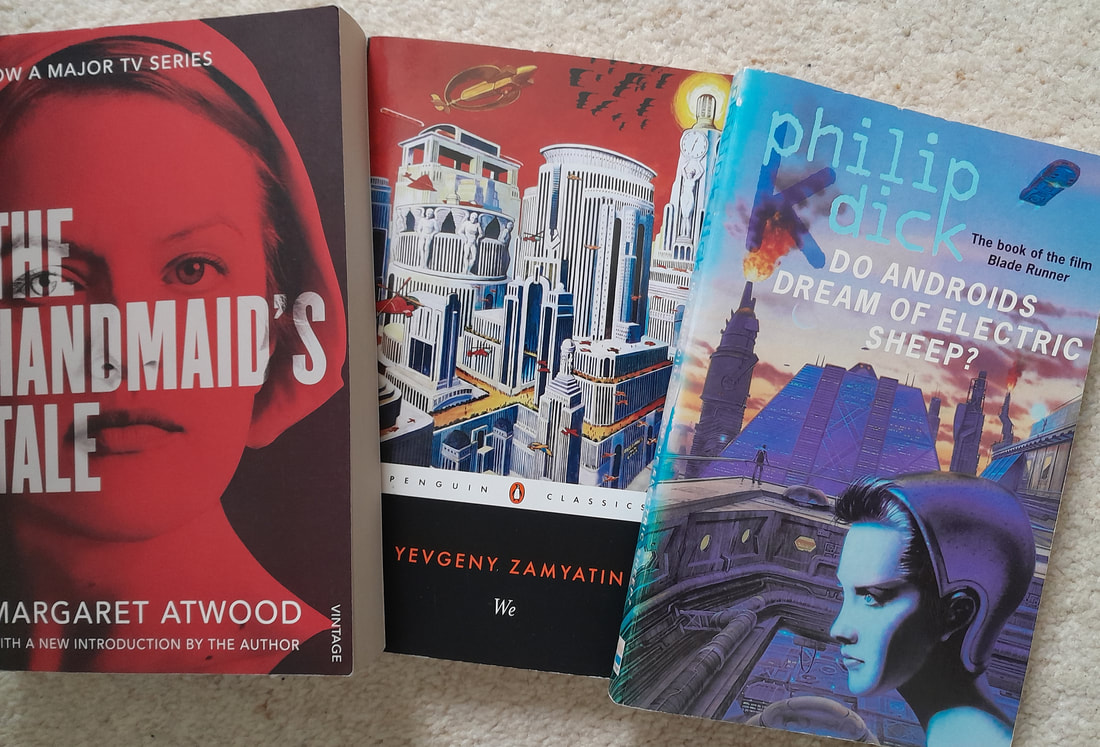 Although these three books influenced my writing of The Waste, there are several other dystopian novels that were significant touchstones too, such as The Handmaid’s Tale by Margaret Atwood, We by Yevgeny Zamyatin and Do Androids Dream of Electric Sheep? by Philip K. Dick, and I would definitely recommend these all as powerful, thought-provoking reads.
The Waste is out now, available in eBook and paperback, and free to read through Kindle Unlimited.
5 Comments
Like any author, I draw upon a broad range of inspirations when writing a book, and for me, visual art has always informed and influenced my writing. Although far from blessed in my drawing and painting skills, I’m rarely happier than when wandering around an art gallery! In this blog post, I am going to focus on four artists who have been particularly important and inspiring to me when I was working on my new novel The Waste. William Blake I have long been fascinated by the work of visionary painter and poet William Blake (1757-1827). His art is both highly personal and highly original, infused with his rebellious spirit and enormous imagination. Encompassing biblical and mythological themes, the delicate strangeness of Blake’s work is powerful and seeing the collection of his work is always a highlight of any visit to the Tate Britain. 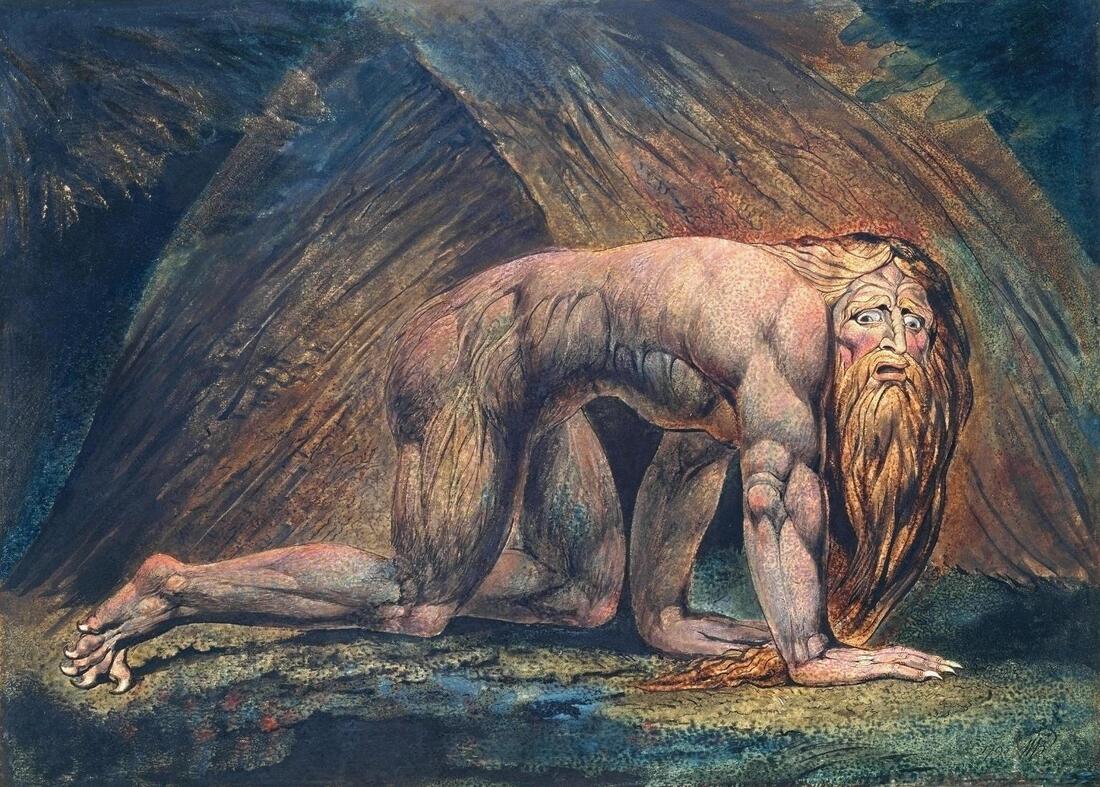 Nebuchadnezzar by William Blake (Tate collection) Through his art and prophetic books, Blake developed a very personal mythology with a host of symbolic characters, and this mythology, along with the graceful, idealised human figures in Blake’s art, was a significant influence for me when writing The Waste, especially when developing the characteristics of the alien Seraphim. The act of developing and writing a novel can be a hard slog, but to spend time researching and thinking about Blake’s art and writings was a pleasure in itself. Paul Nash If I have such a thing as a favourite artist, then I think it would be Paul Nash (1889-1946). Whether it’s the raw, uncompromising power of his First World War art, the melancholy of his Dymchurch paintings or the mythical energy of his work inspired by the Avebury stone circle, I find his work captivating, his symbols resonant and meaningful. Perhaps Nash’s best-known work is We Are Making A New World. I saw the original for the first time in an exhibition at the Imperial War Museum in London. Few paintings have had such an impact on me – the battle-ravaged, brutalised landscape reflected not only the hideous violence of war but Nash’s own emotional experience of the conflict. Consider the pallid sun peeking through the blood-red tide of clouds – is it striving to bring light and hope to the shattered world below, or is it too frightened to peer at the horror Mankind has inflicted? This painting makes an appearance in The Waste and Spare’s experience of viewing it certainly echoes my own. 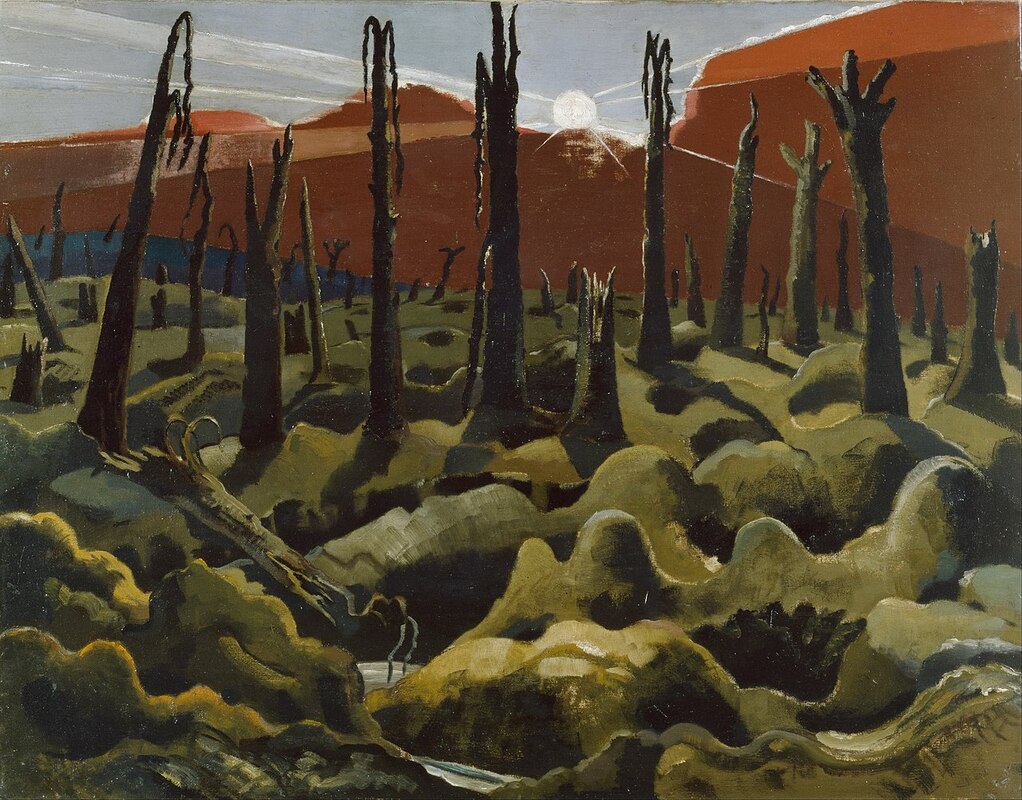 We Are Making A New World by Paul Nash (Imperial War Museum Art collection) Through his paintings Paul Nash demonstrated an intense relationship with landscape, not just recording what his eyes saw, but adding deeply personal levels of symbolic meaning, giving the landscapes he portrayed an animated, vital presence. From his early drawings and paintings, influenced by Samuel Palmer and William Blake, to the harsh angles and blade-like waves of his Dymchurch work, which evoke such a sense of emptiness, of loss and depression, the landscapes of Nash are alive and mythic. This sense of place, the genius loci, as Nash referred to it when he described places such as Avebury, was something I wanted to reflect within my novel. The titular Waste of the book is both a literal and symbolic landscape, where the layers of human history are almost a tangible presence. I have no doubt Paul Nash will remain a primary inspiration for my writing. Dame Elisabeth Frink My first, very striking, encounter with the work of Dame Elisabeth Frink (1930-1993) took place in Bury St Edmunds in my home county of Suffolk. In the grounds of St Edmundsbury Cathedral stands a bronze statue of Edmund, a ninth century king of East Anglia. After being defeated in battle by the Great Viking army, it is said Edmund refused his enemies’ demand to renounce Christ and so was beaten, shot through with arrows and beheaded. Legend tells the Vikings threw Edmund’s severed head into the forest, but it was soon retrieved by those loyal to the king when they followed the cries of a mysterious wolf. Frink’s statue shows King Edmund as a young man, a cross grasped in his hand. This is not a caricature of a warrior or a king – there is pride in Edmund’s face but a sense of vulnerability, his slender body is fragile. Frink’s Edmund is very much a king, a saint, and a martyr, but still a human being. This often-unsettling combination of history, myth and human frailty seems to be present throughout much of Frink’s art. 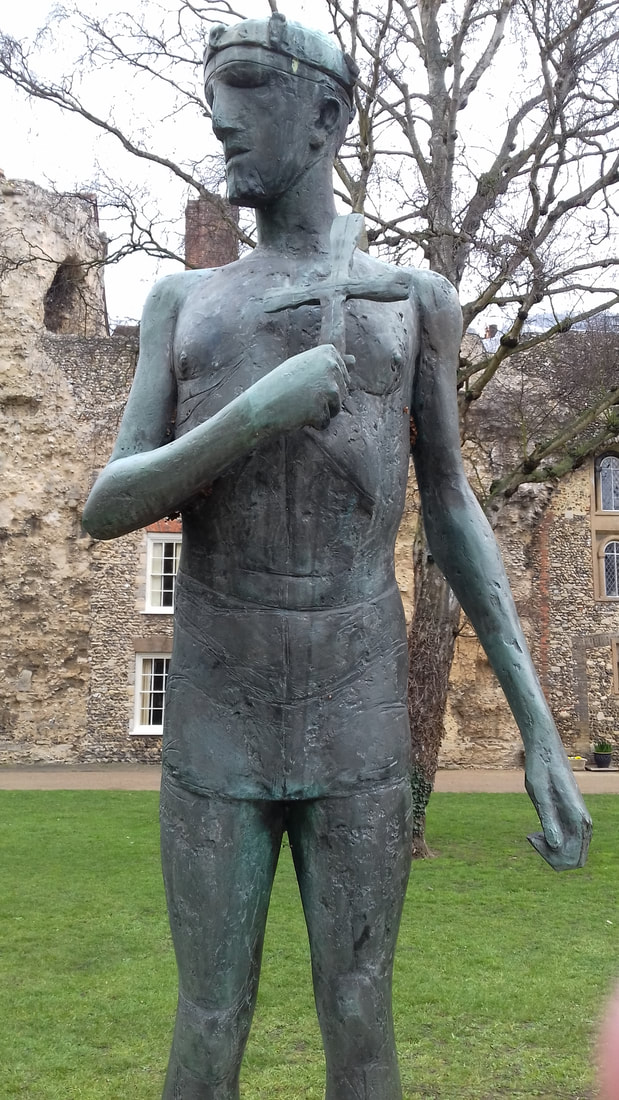 St. Edmund by Dame Elisabeth Frink (St Edmundsbury Cathedral) During the writing of The Waste, I was especially interested by Frink’s goggle head sculptures; shaped by Frink’s interest in themes of masculine aggression, the goggle heads’ sense of faceless authority very much shaped the look and attitude of the Shades, the cold, impersonal, unaccountable police force of my novel. The goggle head sculptures avoid eye contact, concealed behind polished headgear – they are dehumanised and as such offer a threat that cannot be reasoned with. The Shades in The Waste are human, but just as their visors hide their human faces, their humanity is also hidden and they appear almost machine-like, robotic. The unsettling and enigmatic nature of Elisabeth Frink's art continues to be both fascinating and inspiring. 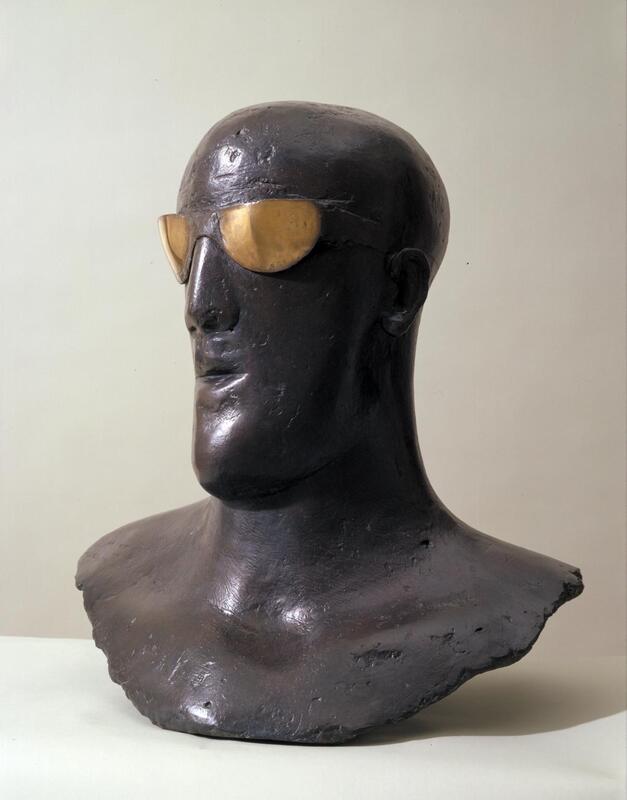 Goggle Head by Dame Elisabeth Frink (Tate collection) Alfred Wallis Alfred Wallis (1855 - 1942) produced profoundly personal art, painting images of ships, boats, Cornish villages and the sea. With no formal art training, Wallis only took up painting after his wife’s death – with little money for materials, he mostly painted on found pieces of cardboard. Wallis painted from memory, drawing on his sea-faring experiences, to capture a rapidly disappearing way of life. Wallis’s limited palette and distorted perspective give his work a distinctive look. Within his paintings, Wallis played with size and scale of objects, and although the paint is roughly applied, he often achieved high levels of detail. Wallis’s instinctive compositions give his paintings real vitality – you can almost taste the briny air, hear the waves booming. 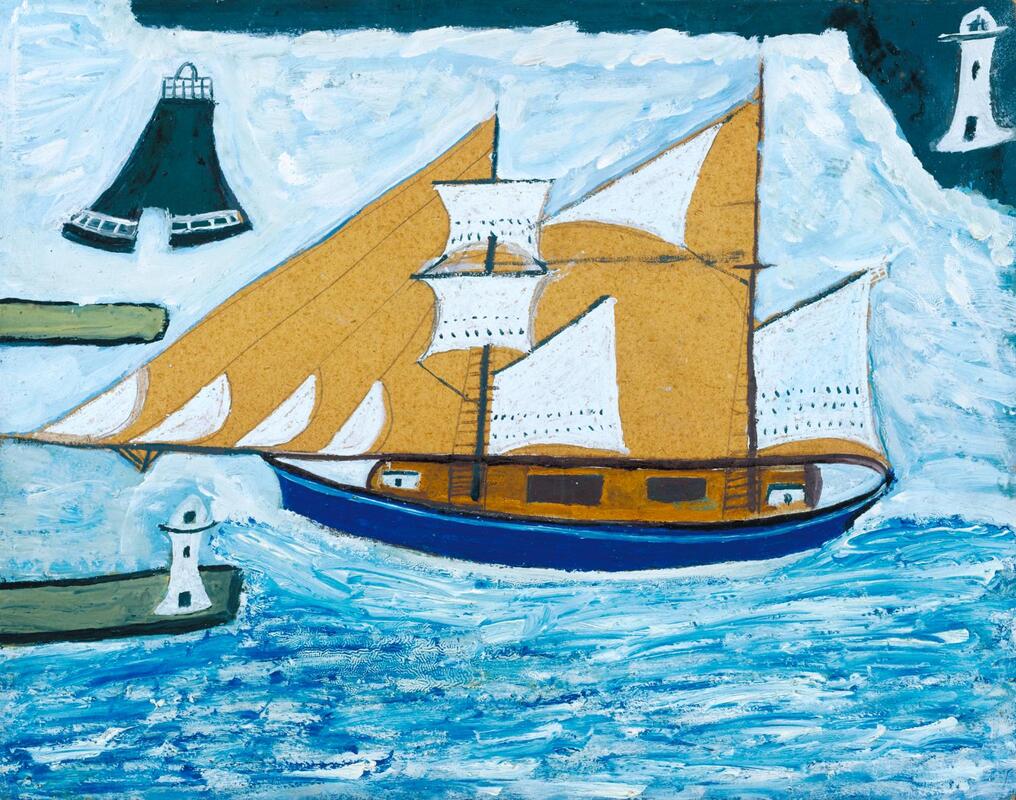 The Blue Ship by Alfred Wallis (Tate collection) The art of Alfred Wallis, and discovering more about his life, unlocked for me the character of ‘The Captain’ in The Waste, who although is not meant to represent the real Wallis, does share many of the same motivations and obsessions. It is important not to romanticise the life of Alfred Wallis – he struggled with poverty and, it would appear, mental health difficulties – but he brought something profound and original into the world, and I hope he gained pleasure from the creation of his art.
The Waste is out now, available in eBook and paperback, and free to read through Kindle Unlimited. Landscape, and a sense of place, has always been important in my writing and my new science fiction dystopian novel The Waste is no exception. The novel moves through London, Gippeswic (an alternate version of Ipswich in Suffolk) to the Waste, which is a massive open-air prison covering a large swathe of south-western England. In this blog post, I will cover some of the real-world locations that helped inspire my novel. London Parts of the novel take place in (a much changed) City of London, with buildings such as the Shard, Saint Paul’s Cathedral, Saint Mary Woolnoth church and Liverpool Street Station appearing in thinly veiled forms. This is an area of London steeped in history, which I always find fascinating and enjoy walking around (especially when quieter at the weekends) and it formed an interesting backdrop to parts of the story. Within the novel, these flashes of history also contrast with the society the Seraphim are encouraging humans to build: a society focused only on the present, only on personal gain and pleasure. The inclusion of Saint Mary Woolnoth church is also a nod to The Wasteland by TS Eliot, which inspired some of the imagery in the novel. 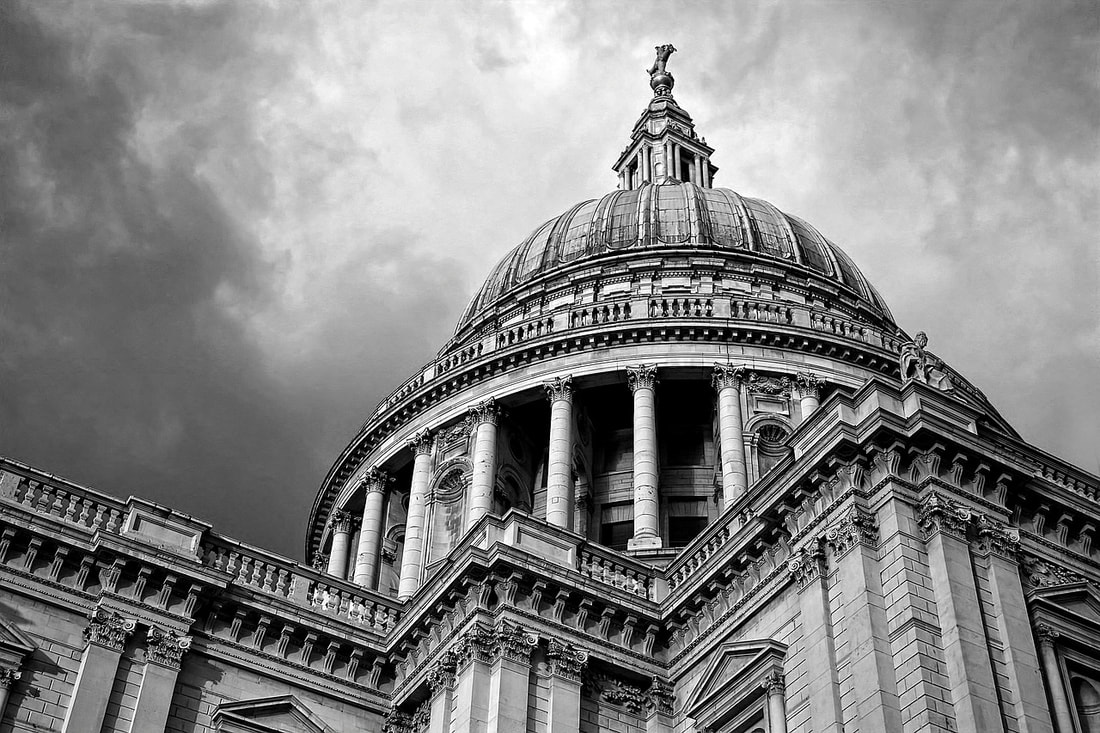 Avebury World Heritage site The area around Avebury in Wiltshire contains an extraordinary cluster of monuments dating to the Neolithic and Bronze Age, including the famous Avebury Stone circle, Silbury Hill and West Kennet Long Barrow. Having been fortunate enough to visit this area on a few occasions, it is difficult to put into words the atmosphere this landscape exudes. As you walk around the henge and stone circle at Avebury, or face the imposing mass of Silbury Hill, or walk up to the mysterious West Kennet Long Barrow, there is a sense of deep time, of landscape shaped by countless layers of human history. From the earliest stages of writing The Waste, Avebury and the surrounding area always formed a key location in the story. In the book, the henge and stone circle at Avebury appears as Havock, the chief settlement of the dreaded Mohock clan, while Silbury Hill emerges in grisly fashion as their chosen place for executions. West Kennet Long Barrow also has a fleeting but important appearance. One of the reasons Avebury interested me in the first place was the work of artist Paul Nash, who has long been one of my favourite artists. Nash had a profound sense of landscape, with a powerful emotional attachment to certain places such as Avebury and Dymchurch, places which possessed a quality he referred to as the genius loci. Although the Waste is a prison, and a dangerous and savage place, it is also less touched and polluted by the modern world – as well as being at times horrifying, I wanted the Waste to be a dreamlike landscape, rich with a sense of history and symbolism. I believe this quote from Paul Nash encapsulates the sense of what I was reaching for:
"The divisions we may hold between night and day - waking world and that of dream, reality and the other thing, do not hold. They are penetrable, they are porous, translucent, transparent; in a word they are not there." 'Dreams', undated typescript, Tate Archive The settings in The Waste are key elements in the novel, both challenging and revealing the characters, and although this is science fiction, they help achieve a sense of reality and history. The Waste is out now, available in eBook and paperback, and free to read through Kindle Unlimited. Image of St Paul's Cathedral by Raygee78 from Pixabay Although I wrote and published four novels before The Waste, my latest book dates back to my earliest attempts to start writing seriously. My first unfinished novel was a serious fiction story called Colony and was set in an alternate Earth occupied by an apparently benevolent alien race. Put simply, I didn’t have the skills or the experience to do the novel justice, so I abandoned the book and switched my efforts to writing for small press and indie SF / fantasy magazines for a couple of years before embarking on my first completed novel, the epic fantasy The Map of the Known World. And yet over the years, as a lover of science fiction and dystopian novels and films, the basic premise of Colony stayed with me. After completing my fourth novel, the historical fantasy This Sacred Isle, I returned to my SF story. The first thing that changed early in the writing was the title as Colony was the name of the (excellent) SF series starring Josh Holloway and Sarah Wayne Callies. My unfinished novel was also more of a police procedural but I moved away from that approach. However, one element that did remain was that of the aliens being, at least on the surface, benign, with their rule of Earth largely supported and unchallenged by humanity. 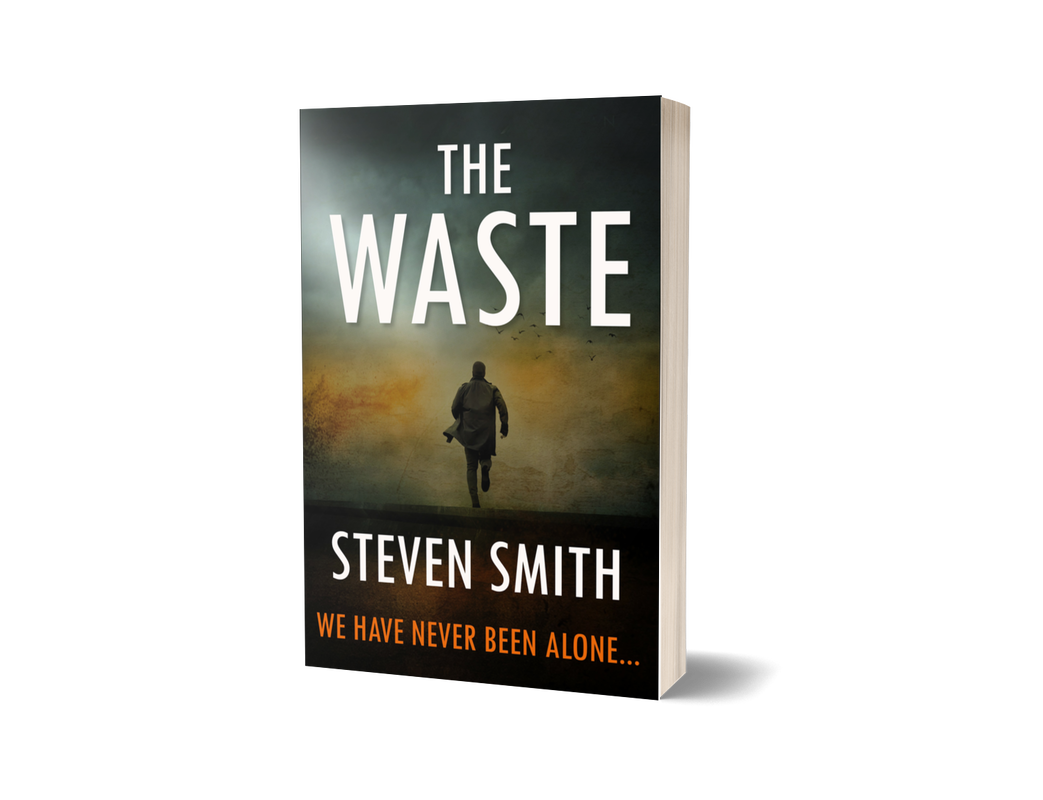 Although my primary aim when writing any novel is to intrigue and entertain the reader, in The Waste I wanted to explore contemporary concerns and themes. So, for the setting of the book, I wanted a world with clear roots and parallels with our own. The Waste is set in an alternate version of modern Britain, for although this is a science fiction novel with aliens and spaceships, there is also homelessness, foodbanks, environmental damage, poor public housing, and the mistreatment of immigrants. For some, the new society created by the Seraphim is a paradise; for many others life remains a painful daily struggle. The world of The Waste is a dystopia, but a dystopia hiding in plain sight, where the quest for money, power and status is treasured above all else, where poverty is judged to be a symptom of personal weakness, where compassion for the suffering of others is seen as misguided, mawkish. In this world, all the functions of government, along with almost all commercial enterprises, are run by the vast, monolithic PAX company. The main character of The Waste is Percival Spare. By the metrics of his life – career, relationships, money – Spare believes he has utterly failed. He is lonely, unfulfilled and routine-trapped. In many ways, Spare’s journey as a character is not so much about taking risks – although that is certainly part of it – but about seeing, really seeing, the injustices of the world and realising he must do something, however small, however insignificant, to stand against these injustices. 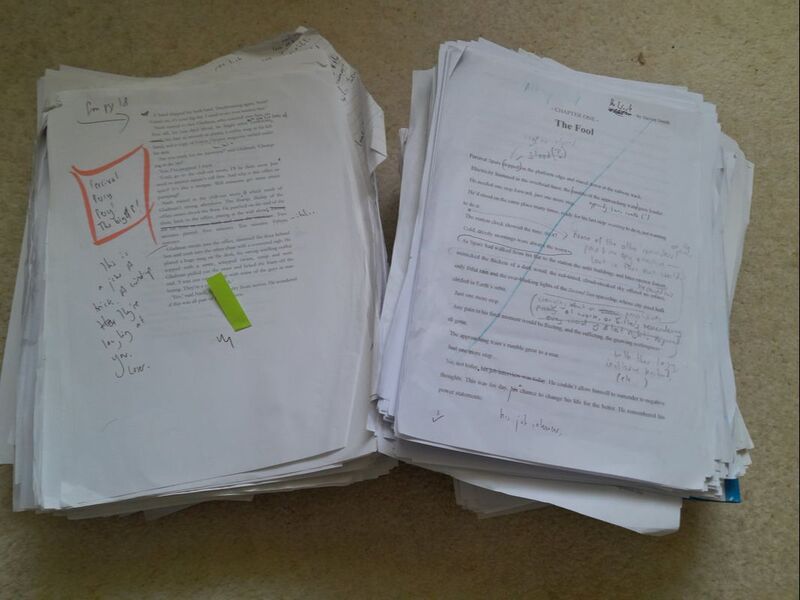 Just some of the many drafts of The Waste! The Waste is a novel that went through many iterations, and although you can never be sure how a book will be received by readers, I was sure this was a book I wanted to write, felt compelled to write in some ways, and that provided ample motivation through the many years it took to reach the final version.
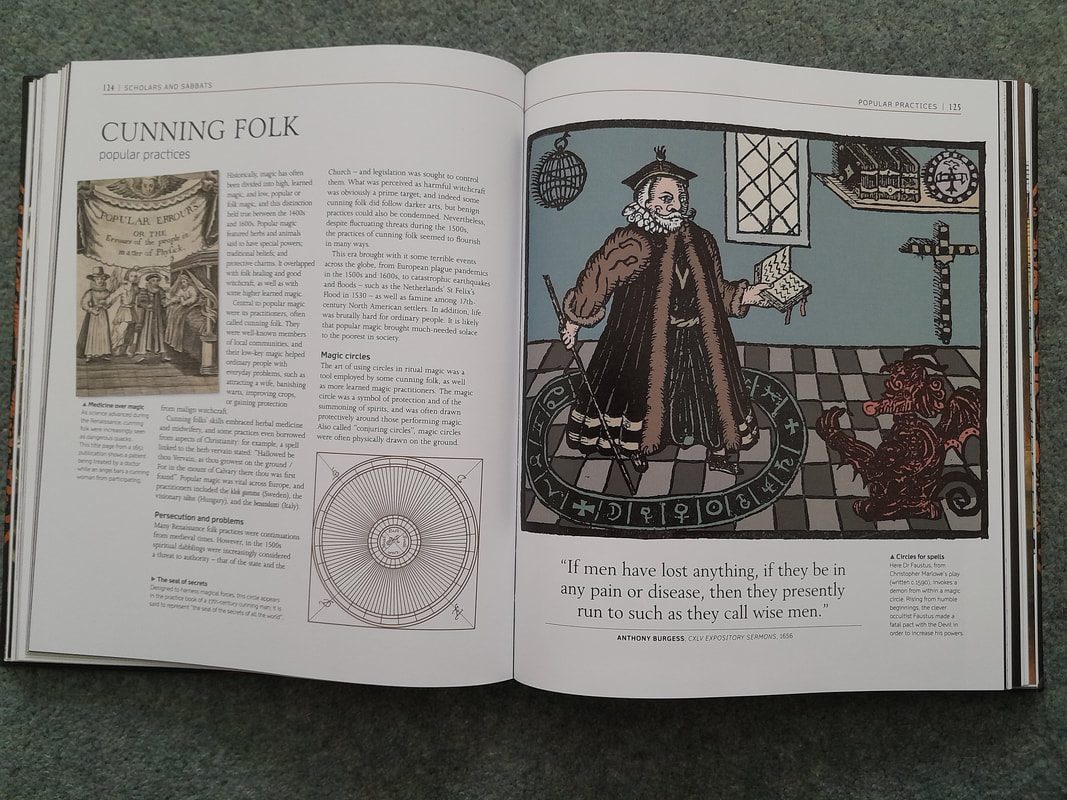
The Waste is published on 27 October - the eBook version is available for pre-order for just £0.99 / $0.99. Professor Suzannah Lipscomb’s excellent foreword to A History of Magic, Witchcraft & the Occult sets the tone for this fascinating book, which explores how humans have sought to understand the universe and their place within it, and how they can appease or control spiritual forces to influence their environment. As seems to be standard with DK titles, the book is beautifully designed, with lavish illustrations (including paintings, photographs and woodcuts) and quick-fact panels to define and explain key information. The book is an intriguing journey through magical history, travelling from prehistoric times to the modern world, encompassing divination, alchemy, shamanism, Wicca and so much more. The broad historical narrative unfolds chronologically and takes a global view, drawing on cultures, beliefs and practices from across the world. There are many highlights I could mention, but I found the chapters on Mesopotamian magic (I’d also recommend The First Ghosts by Irving Finkel on this topic) and Renaissance folk magic especially engrossing. 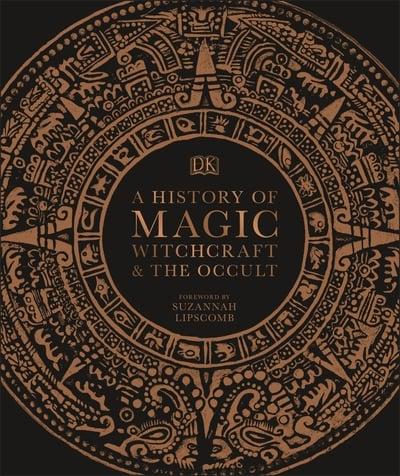 I bought the book as part of research for my latest novel, and while it has certainly proved useful in that regard, it is also a pleasure to read and there is always something unexpected to find. The sheer scope of the book inevitably means the subjects are not explored in great depth, but there is enough detail to interest the reader and to encourage further and research. A History of Magic, Witchcraft & the Occult gives the reader a good sense of the important role magical practices and beliefs have played in shaping civilisations around the world, and the ways in which they continue to enrich many people’s lives. So, whether you’re looking to discover more about the Hermetic Order of the Golden Dawn, Mayan cosmic cycles, tarot or countless other magical subjects, you’ll find something in this book to spark your imagination or inspire your creativity. If you’re interested in learning more about the history of magic, I would also recommend The History of Magic by Chris Gosden (which gives a more in-depth survey of the subject, and which I reviewed in a previous blog post), and from a British perspective, Pagan Britain by Professor Ronald Hutton and The Book of English Magic by Philip Carr-Gomm and Richard Heygate. In the summer of 1962, with his mother recuperating from an illness, young Luke Kirby is sent to stay with his Uncle Elias, (who Luke has never met) in a village called Lunstead. Elias soon reveals himself to be a magician, and he is keen to pass his skills onto his nephew. But as Luke begins his magical apprenticeship, a deadly horror reveals itself… Written by Alan McKenzie, and illustrated by John Ridgway and Steve Parkhouse, Summer Magic: The Complete Journal of Luke Kirby is a collection of tales (originally printed in 2000AD), which coalesce into an overall story arc. The stories are varied, for example: The Night Walker, where Luke must confront a vampire; Sympathy for the Devil, where Luke travels to hell (an unnervingly original version of the underworld) in search of his father; and (possibly my favourite in the book) The Old Straight Track, which delves deep into British mythology and folklore, becoming a memorable folk horror tale infused with paganism, during which Luke—guided by the mysterious alchemist called Zeke— travels through a landscape marked by ley lines, stone circles and long barrows. For me, there are echoes of the work of Alan Garner with the close connection between the landscape and the characters. 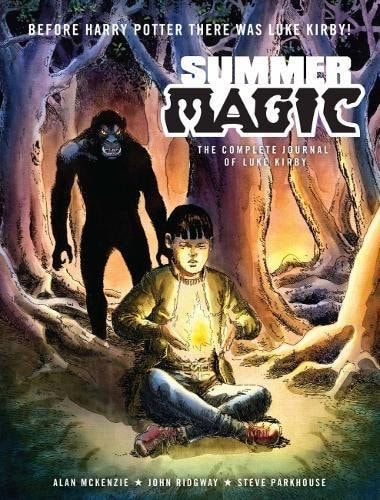 Summer Magic is a compelling collection, with stories that in places pack a disturbing punch. Throughout the book, the beauty and mystery of the English countryside is beautifully evoked through the writing and the stunning artwork. And beneath that beauty, and within the sleepy streets of the villages and little towns, true horrors lurk… Through all the stories run themes of death, family and horror, and as Luke develops his magical and alchemical skills, he learns that all actions, however well-intentioned, have consequences. Within Summer Magic, there is more than a little sense of the challenging, hard-edged fare of 1970s British cinema and TV (this is definitely a story for the Scarred for Life generation). Summer Magic: The Complete Journal of Luke Kirby is a great collection—a coming-of-age tale but with a 2000AD edge, an excellent example of the dazzling range of creativity that has poured from the comic’s pages over the decades. If you’re read and reread all of the Harry Potter books, or just finished binge-watching series 4 of Stranger Things, you will find much to enjoy in this dose of Summer Magic. If you want to find out more about Summer Magic: The Complete Journal of Luke Kirby, I'd recommend this excellent short introductory video made by 2000AD: Greybeard is a science fiction novel by the British author Brian Aldiss, published in 1964. In 1981 humans and most mammals were rendered sterile by the ‘Accident’. By 2029, the youngest generation of humans are in their fifties, with no younger generations to follow. With civilisation collapsed, the remaining people eke out an existence in small, fearful communities, knowing humanity’s ultimate demise is close at hand. Greybeard (real name Algy Timberland) and his wife Martha abandon their crumbling settlement and set-off on a boat trip down the Thames, travelling through a landscape changed by the collapse of human civilisation and the resurgence of nature. Along the way Greybeard and Martha encounter other, strange communities, where the inhabitants often fall prey to profiteering hucksters and false prophets seeking to exploit the desperate need for hope in a fallen world. Foremost among such charlatans is the gloriously named Bunny Jingadangelow, who claims to possess the secrets of youth and immortality—when Greybeard and Martha encounter Jingadangelow later in the story, he has elevated himself as a religious figure, the Master, and through a mix of charm, deception and cunning, has gathered loyal followers who treat him like a god. 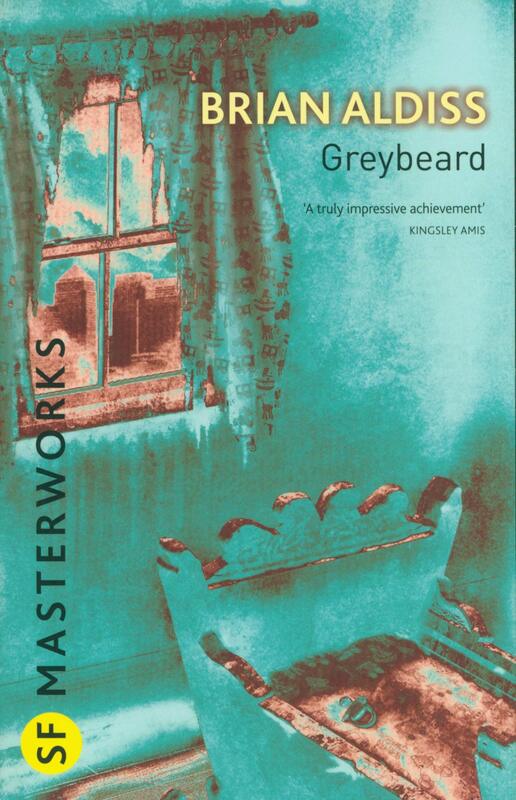 As well as following Greybeard’s and Martha’s journey, flashbacks explore the effects of the self-inflicted ‘Accident’: the war, the descent into anarchy, the disease, the madness. The chapter where Greybeard and Martha encounter local tyrant Peter Croucher I found especially striking and darkly comic, as Croucher tries to enforce a brutal order after the national government in Britain disintegrates—Croucher is power-hungry, humourless and insecure, as witnessed by his fear of intellectuals and his mangled attempts to prove his own intelligence. The rise to power of such a figure in chaotic times is painfully plausible and carries a warning we should all heed.
This is a haunting and sombre book, with a memorable depiction of a slow, quiet but unstoppable human catastrophe. The world of Greybeard is richly described, with a continual and potent contrast between the vigour and fecundity of nature (as it covers over roads and buildings, reoccupying lands previously lost to humans) and the decrepitude of humanity. There is the sense that the rule of humans is but a brief interruption and that nature might in time erase all trace of our species. Despite the bleakness, there are tiny slivers of hope, with rumours and sightings of humanoid beings—for example, the talk of elves and gnomes hiding in the forests—suggesting there might be a future for humanity, albeit one very different from what came before. Exploring themes of aging, death, religion and power, Greybeard is a powerful and thought-provoking novel from a master of science fiction. If you spend any time in the lonely places of the British countryside – the deserted beaches, the dense forests, the Fens, the hills and mountains, the still ponds and lakes, the ruins half-swallowed by time – then you’ll be familiar with the occasional fleeting sense of there being something just out of sight, just out of hearing, a sense of watchfulness, of secrets and trauma long-hidden. It is these wild places, and the effect they have on us, that Edward Parnell explores in his outstanding book Ghostland – In search of a Haunted Country. In the best way, Ghostland is a difficult work to categorize. It is a book of haunted landscapes and haunted lives, a book filled with folklore, natural history, psychogeography and cinematic and literary references, all underpinned by the author’s deeply moving personal story. 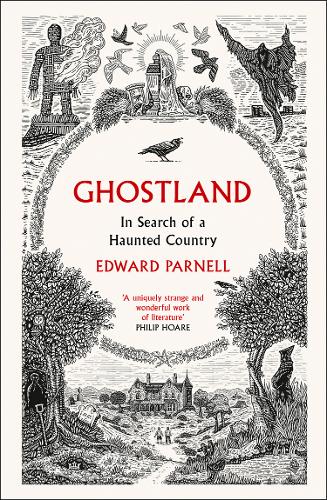 Whether exploring the crumbling cliffs and lonely beaches of Suffolk, or the sprawling Glasgow Necropolis, or the rugged coast and Neolithic moorlands of West Cornwall, and many locations in between, Parnell invokes a powerful sense of place and the stories and ghosts that surround and infuse them. Ghostland shines a light on some of Britain’s finest writers of horror and the uncanny, such as M.R. James, William Hope Hodgson, Arthur Machen and Alan Garner, showing how their obsessions and fears, and connections to their landscape, shaped their creations, often in unsettling ways. Although some of the authors mentioned in the book I am familiar with, there are others whose work I didn’t know, so one of the joys of Ghostland is discovering a list of novels and short stories I now can’t wait to read.
As well as ghostly literary tales, on-screen horrors are explored too, and not just folklore-inflected cinema and television such as The Wicker Man, The Children of the Stones and Jonathan Miller’s peerless M.R. James adaptation Whistle and I’ll Come To You (still an intense, disturbing experience), but also the dark strain of British public information films, which are vividly remembered, most likely in our personal and collective nightmares, by the generation exposed to them. For example, Lonely Water, a nightmarish warning of the perils of swimming in dangerous places (narrated with spine-tingling relish by Donald Pleasance), and Apaches, a terrifying short film I remember being shown at primary school – if the aim of Apaches had been to convince children growing up in rural Britain in the 1970s and 1980s that the countryside was filled with hidden and gruesome threats, then, from my perspective at least, it succeeded… I think anyone reading this book will find some moments of connection and resonance, whether in Parnell’s deep love and reverence for the natural world, his fascination with stories of the uncanny or in his sensitive but unflinching description of his own personal tragedies. For me, Ghostland demonstrates how our cherished places and stories – in any form – can help us manage and make sense of our real-life struggles. The best ghost stories don’t just frighten or excite us, they help to remind us to acknowledge painful memories – our own ghosts of the past – to help us move forward, to help us keep going, even when stricken with loss and grief. From the first page of Ghostland to the last, I fell under its haunted spell; I have no doubt it is a book I will revisit and reread, and I am sure every time I open it, I will find new treasures – and new horrors – buried within its pages.
Stories come alive through the voices of their characters. To capture the natural rhythms and flow of human conversation is not an easy task, but in this blog post, I am going to give some tips on how you can create dynamic dialogue to enhance your storytelling.
There are three key aims your dialogue must achieve:
Keep it real (sort of) Although you want your dialogue to sound natural and to flow, you don’t want to replicate the structure of real speech, which is often full of unfinished sentences, repetition, pauses and stumbles over words – of course, you might want to add these in occasionally when it fits the moment, but do so very sparingly to avoid your dialogue becoming too ragged for the reader to follow. 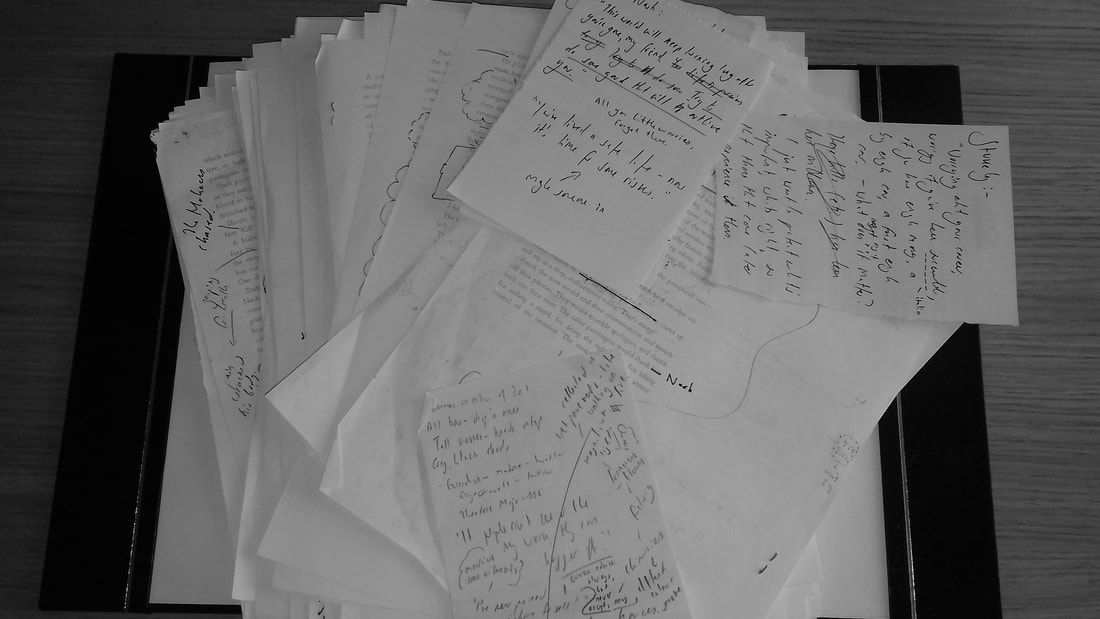
Keep it brief and avoid small talk
Pages and pages of dialogue can be trying for the reader, so try to keep it focused – avoid any conversation that fails to achieve any of the three key aims mentioned above. Never info dump You should only dispense exposition through dialogue very sparingly – in particular, don’t state things both characters would clearly already know. Dumping exposition risks making your dialogue stodgy and stilted. Give each character a recognisable voice All humans express their thoughts in a unique way. A character’s background should influence the way they speak – their tone, use of language, any slang and dialect phrases. Once you’ve established a character’s voice, make sure you are consistent throughout the story. Show not tell Don’t signpost your characters’ emotions. As people, we’re not always precisely aware of how we feel, let alone be willing or able to express that emotion. Rather than having a character explicitly say ‘I’m angry’ or ‘I’m worried’, try to describe body language as indicators, clues even, for your readers to use. Dialogue tags Of course, when reading dialogue, your reader needs to know which character is speaking. The standard way of doing this is to apply dialogue tags such as ‘She said’ or ‘Jo cried’. Sometimes, additional verbs and adverbs are used such ‘she said sadly’ or ‘Jo cried angrily’ – I find these intrusive, especially if over-used; again, these run the risk of telling not showing the reader how a character is feeling or reacting. I tend the use the bare minimum of dialogue tags, basically just enough ‘he / she said’ so the reader can follow and know who is speaking - I feel this helps the dialogue flow and keeps the reader’s focus on what is being said. My final tip is to read your dialogue scenes out loud – this helps to identify any words or phrases that fail to ring true for the characters.
If you’re interested in my writing, you can get the ebook version of my first novel - The Map of the Known World – for FREE. Please see the following Kindle preview:
All authors draw on a wide range of inspirations when creating their stories, such as real-life experiences, places they have visited, concerns about the world and society, books they have read. For me, visual art has always inspired and influenced my writing. I cannot claim to be an expert in art history, and as much as I enjoy sketching my artistic skills are limited at best, but I find it an endlessly absorbing subject and a way of finding different perspectives on the world. By offering us a safe space to consider and explore feelings and fears we otherwise feel uncomfortable in confronting, art can help us all feel a little less alone in this world.
In this blog series, I am going to focus on four artists who have been particularly important to me and my creative work: Ian Miller, Elisabeth Frink, Paul Nash and Alfred Wallis. In this post, I am going to discuss the work of Paul Nash. Sometimes your appreciation of an artist develops over time – you slowly connect to their style, craft and symbolism. Other artists are like love at first sight: the first glimpse of a painting or sculpture creates an instant connection, an instant meaning. For me, Paul Nash is definitely in the latter category. Whether it’s the raw power of his First World War art, the melancholy of his Dymchurch paintings or the mythical energy of his abstract work inspired by the Avebury Stone Circle, I find his work endlessly fascinating, his symbols resonant and meaningful. I even named my small publishing company after Nash’s series of Monster Field photographs. 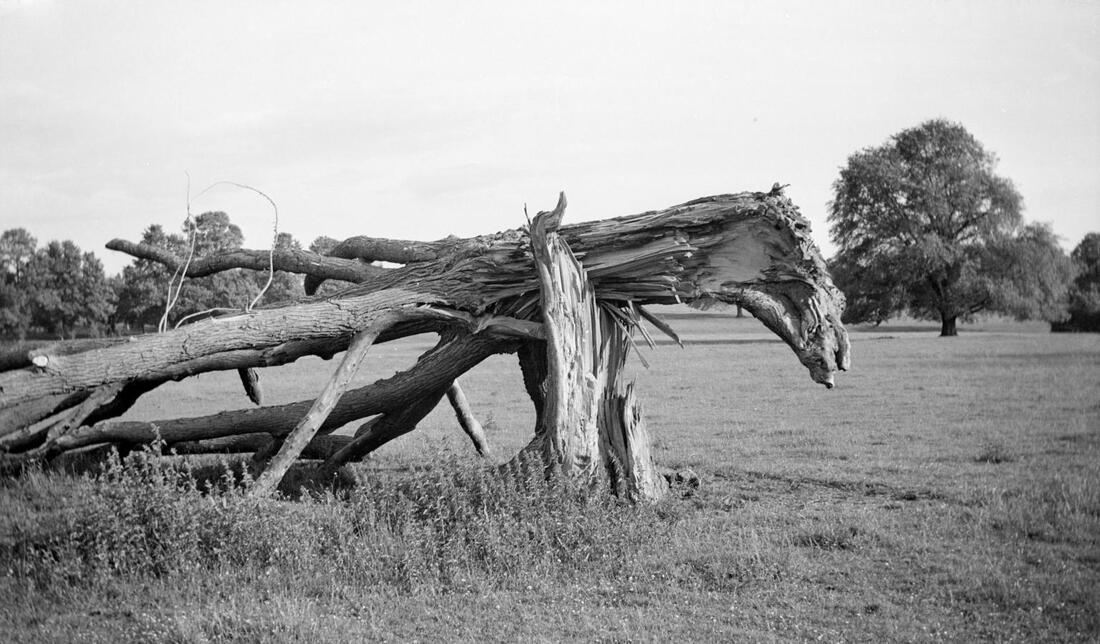
Black and white negative, ‘Monster Field’ - Paul Nash
One of the most influential British artists of the twentieth century, Paul Nash demonstrated an intense relationship with landscape, never just recording the topography, not just recording what his eyes saw; instead he added deeply personal levels of symbolic meaning, giving the landscapes he portrayed an animated, vital presence.
Born in 1889, Nash’s early work was influenced by the Pre-Raphaelites and William Blake, and produced drawings and paintings of dream-like landscapes, often peopled with mysterious figures. In particular, Nash filled his trees with life, almost giving them personalities of their own: "O Dreaming trees,
As with millions across the world, Nash’s life changed with the outbreak of the First World War. He enlisted in the Artists’ Rifles in September 1914 and was stationed in England until deployed to the Ypres Salient in March 1917. This spell on the Western Front proved short-lived, as Nash suffered a non-combat injury and was invalided home. He returned to Belgium in October 1917 as an official war artist, depicting the shattered landscape.
Not only did war change Nash’s life, it also transformed his art. Perhaps the most famous painting of Nash in this period is We Are Making A New World. This is a painting I had seen reproduced many times but I saw the original for the first time in an exhibition at the Imperial War Museum in London. Few paintings have had such an impact on me – the ravaged, brutalised landscape reflected not only the violence of war but Nash’s own emotional experience of the conflict. Sometimes I see this as a hopeful painting; other times I feel it is filled with despair. Look at the pallid sun peeking through the blood-red tide of clouds – is it striving to bring light and hope to the shattered world below, or is it too frightened to peer at the horror Mankind has inflicted?
'We are Making a New World' by Paul Nash
After the war, Nash moved to Dymchurch in Kent, where he made a series of stark paintings of the sea and coastal defences. Nash, who had nearly drowned as a child, portrays the sea as menacing and cold – the harsh angles and blade-like waves are as threatening and desolate as No-Man’s Land, the grim memories of war spilling over Nash’s work even in peacetime. To me, the paintings evoke a sense of emptiness, of loss and depression.
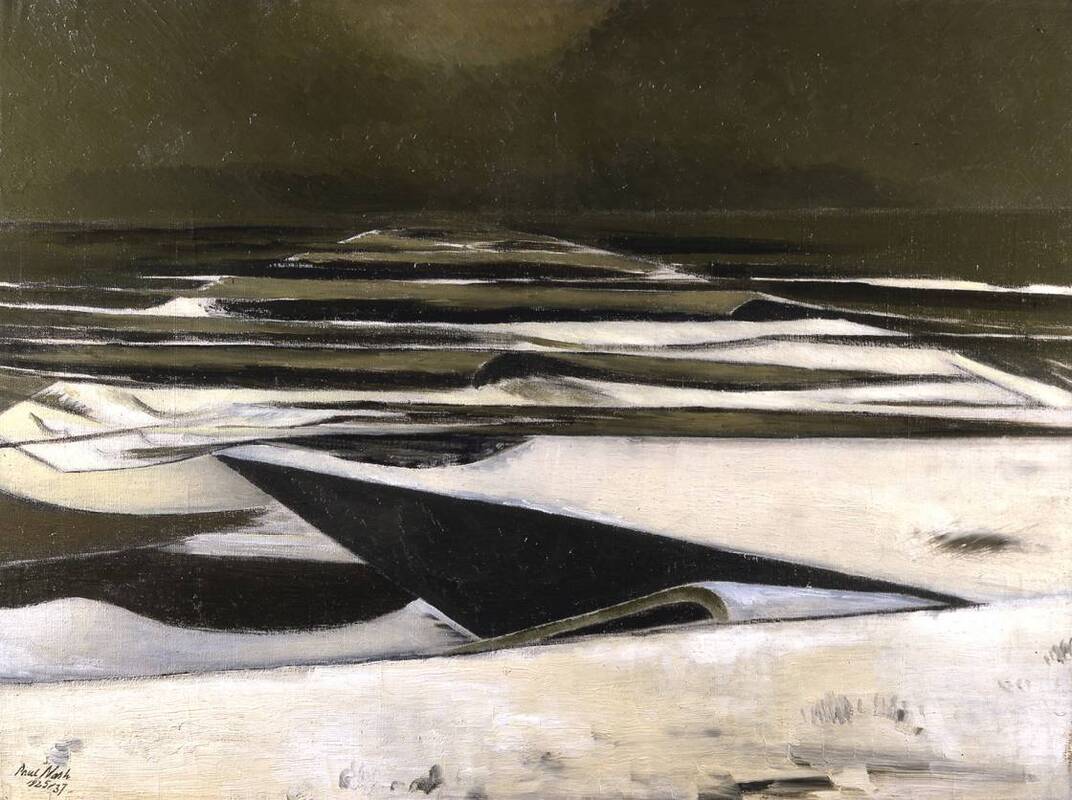
'Winter Sea' by Paul Nash
The Dymchurch paintings show again Nash’s connection to landscape, and it is this connection that has most influenced me as a writer. For example, when writing my novel This Sacred Isle, Nash’s symbolic landscapes remained at the forefront of my thinking. I wanted to present the landscape of that story as liminal and to show traces of the history it had witnessed, where there exist forces and influences beyond what is normally visible. To quote Nash:
"The landscapes I have in mind are not part of the unseen world in a psychic sense, nor are they part of the Unconscious. They belong to the world that lies, visibly, about us. They are unseen merely because they are not perceived."
Paul Nash had a powerful emotional attachment to places such as Avebury, which he said possessed a quality he called the genius loci.
This sense of places having its own 'character' or 'spirit' was something I tried to create within This Sacred Isle, for example, in the scene Morcar meets the Stag Lord, a scene that plays out in a dreamlike, symbol-laden landscape. A quote from Paul Nash captures the feeling I was trying to achieve: "The divisions we may hold between night and day - waking world and that of dream, reality and the other thing, do not hold. They are penetrable, they are porous, translucent, transparent; in a word they are not there."
Nash’s connection with Avebury inspired me to visit the stone circle, and once there I could understand why it held such a fascination for the artist – combined with the surrounding landscape, encompassing sites such as Silbury Hill and West Kennet, it forms such an evocative place, steeped in history and myth. Avebury is an important location in my next novel, Second Sun, and this is in no small part due to the influence of Paul Nash – for me, and I’m sure many other people, his work will remain an ongoing inspiration.
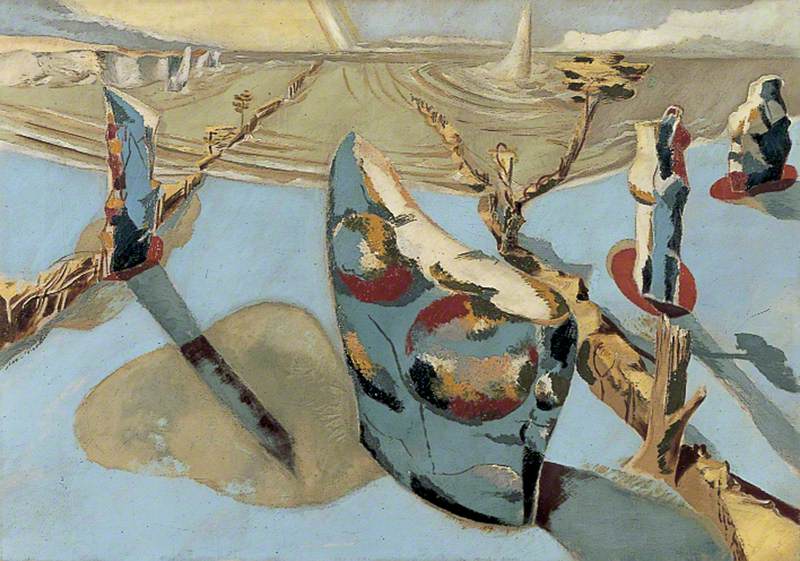
'Circle of the Monoliths' by Paul Nash
Part 1 - Ian Miller
Part 2 - Alfred Wallis Part 3 - Elisabeth Frink If you’re interested in my writing, you can get the ebook version of my first novel - The Map of the Known World – for FREE. Please see the following Kindle preview: |
Archives
October 2023
Categories
All
|
 RSS Feed